
Guide
Who is responsible for waterproofing in strata in NSW?
In NSW the owners corporation is usually responsible for waterproofing that was put in when the building was registered as a strata scheme, including original floor tiles and waterproofing on common property floors. If an owner later renovated a bathroom or balcony and laid new tiles and waterproofing, that work is usually the owner's to maintain. The building's strata plan, its by-laws and any approval given for the renovation decide the cases in between.
Water damage follows the same logic. Who pays depends on where the water came from, not where the stain showed up. The first job is always finding the source.
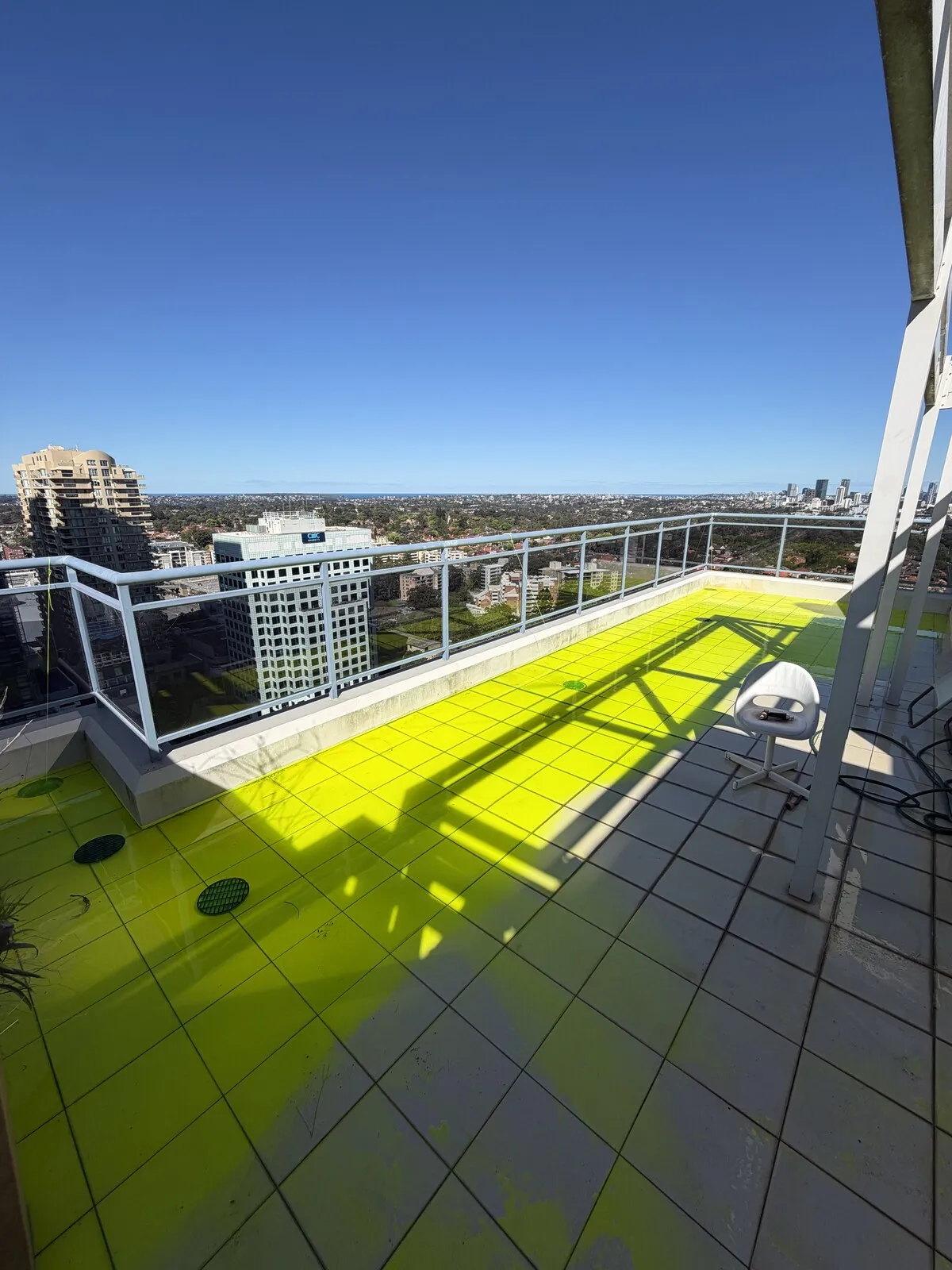
Original or renovated: the question that decides most cases
Many NSW schemes adopt the government's common property memorandum. Our guide to strata plumbing responsibility in NSW explains how it works alongside the strata plan and the Act. For waterproofing it draws one clear line. The owners corporation's list includes "original floor tiles and associated waterproofing affixed to common property floors at the time of registration of the strata plan". The lot owner's list includes "floor tiles and any associated waterproofing affixed by an owner after the registration of the strata plan".
| Situation | Usually responsible |
|---|---|
| Original bathroom, waterproofing on a common property floor has failed | Owners corporation |
| Original balcony tiles and waterproofing have failed | Owners corporation |
| Bathroom renovated by a past or current owner, new waterproofing has failed | Lot owner |
| Shower mixer, waste or tap inside the unit is leaking | Lot owner |
| Renovation approved by the owners at a general meeting (a special resolution) | Whoever the approval names for ongoing maintenance |
So original tiles and waterproofing on a common property floor are not automatically the owner's problem when the scheme uses the memorandum.
Is waterproofing covered by strata?
Original waterproofing on common property usually is. Waterproofing an owner added later usually isn't, unless the approval for that work says otherwise. If you've bought a unit with a renovated bathroom, ask the strata manager whether the renovation was approved and what the approval says about maintenance. That paperwork can matter more than the age of the tiles.
Bathroom and balcony renovations change the answer
An owner can't treat waterproofing as a minor renovation. Section 110(7) of the Strata Schemes Management Act 2015 says the minor renovations pathway does not apply to "work involving waterproofing". Waterproofing work affecting common property needs a special resolution under section 108 instead.
Section 108(3) requires that resolution to "specify whether the ongoing maintenance of the common property once the action has been taken is the responsibility of the owners corporation or the owner." If your bathroom was renovated with approval, the resolution should tell you who looks after the new waterproofing.
Strata responsibility for water damage
The NSW Government's strata repairs and maintenance guide puts "water damage coming from common property" on the owners corporation's side and "water damage coming from inside your property" on the owner's side. A leak through failed original waterproofing on a common property floor is usually the building's. A leak from your own washing machine hose is usually yours.
If the owners corporation fails to keep common property in repair, section 106(5) of the Act lets an owner recover "any reasonably foreseeable loss suffered by the owner as a result" as damages. That claim has conditions. There has to be a breach of the duty and loss caused by it. It doesn't mean strata automatically pays for everything a leak touches. Contents and insurance are separate questions for your policy and the building's.
Is a leaking shower covered by strata in NSW?
It depends on what's failing. A worn shower mixer, a leaking tap or a loose waste inside your unit is usually yours to fix. Failed original waterproofing under a bathroom floor that sits on common property is usually the owners corporation's in a scheme that uses the memorandum. Failed waterproofing from an owner's renovation is usually the owner's.
Find the source before anyone pays
When water comes through a ceiling from the unit above or from a balcony, work through it in this order:
- Stop the water if you can. If the source is a fixture in your own unit, turn it off. If it's coming from above, tell the strata manager straight away.
- Take photos of the damage, the ceiling or wall and any water on the floor.
- Get the source traced. A plumber checks whether the water is coming from a pipe, a fixture or the waterproofing. That's what decides who pays.
- Find out the bathroom's history. Ask the strata manager whether it is original or was renovated and whether the work was approved.
- Check the strata plan and by-laws. They show the lot boundaries and whether the scheme adopted the memorandum.
We fix the plumbing side: leaking pipes, wastes, taps and mixers. If the cause is failed waterproofing, we'll tell you that and give you the finding to take to the strata manager, who works out who pays for the repair. Where the membrane has failed, we bring in a waterproofer for that part and do the plumbing work ourselves.
If you manage the building and need the source traced, see how to arrange a strata plumbing visit.
If you need a plumber in Leichhardt to trace a leak in a unit, tell us where the water first showed up and whether it is still coming through.
When a newer building has a waterproofing defect
If the building is fairly new, the builder's statutory warranties under the Home Building Act 1989 may apply. Section 18B includes a warranty that "the work will be done with due care and skill". Section 18E sets the warranty period at "6 years for a breach that results in a major defect in residential building work or 2 years in any other case".
Waterproofing is one of the major elements listed in section 18E. A waterproofing fault only counts as a major defect if it also meets the Act's test for its consequences. Not every leak gets the six-year period. A claim against a builder doesn't take away the owners corporation's duty to keep common property in repair.
Frequently asked questions
What repairs is the body corporate responsible for in NSW?
The owners corporation (the body corporate) usually looks after roof and gutters, boundary walls, the concrete slab, balconies and balcony doors, windows, plumbing in boundary walls and under the floor and water damage coming from common property. That list comes from the NSW Government's guide. Your strata plan and by-laws can change it.
Who pays if water from the unit upstairs damages my ceiling?
It depends on where the water came from. If it came from a fixture inside the unit upstairs, that owner is usually responsible. If it came from a common property pipe or original waterproofing on a common property floor, the owners corporation usually is. The NSW guide puts ceilings with the owners corporation except for painting, unless the problem is due to changes the owner has made.
Who pays to fix waterproofing in a renovated bathroom?
Usually the owner of that unit, whether they did the renovation or bought it already done. If the renovation was approved by special resolution, the resolution must say who looks after it.